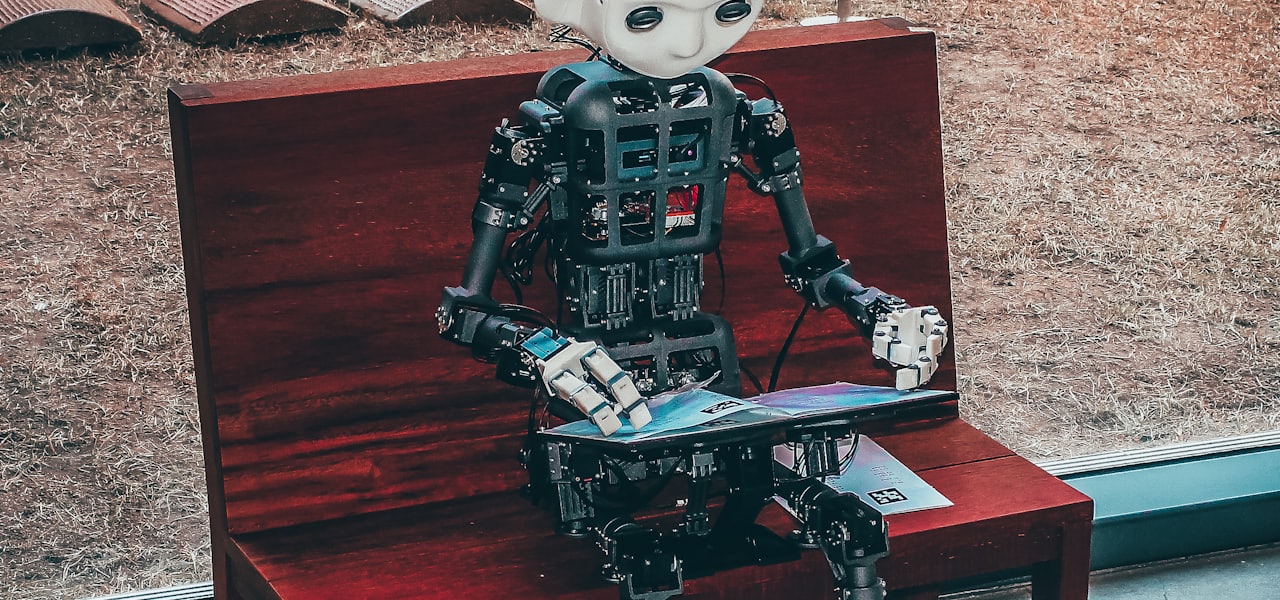
"Computing Machinery and Intelligence" is a paper written by Alan Turing on the topic of artificial intelligence. The paper, published in 1950 in Mind, was the first to introduce his concept of what is now known as the Turing test to the general public. Turing's paper considers the question "Can machines think?" Turing says that since the words "think" and "machine" cannot clearly be defined, we should "replace the question by another, which is closely related to it and is expressed in relatively unambiguous words." To achieve this objective, Turing proposes a three-step approach. First, he identifies a simple and unambiguous concept to substitute for the term "think." Second, he delineates the specific "machines" under consideration. Third, armed with these tools, he poses a new question related to the first, which he believes he can answer in the affirmative. == Turing's test == Rather than trying to determine if a machine is thinking, Turing suggests we should ask if the machine can win a game, called the "Imitation Game". The original Imitation game, that Turing described, is a simple party game involving three players. Player A is a man, player B is a woman and player C (who plays the role of the interrogator) can be of either sex. In the Imitation Game, player C is unable to see either player A or player B (and knows them only as X and Y), and can communicate with them only through written notes or any other form that does not give away any details about their gender. By asking questions of player A and player B, player C tries to determine which of the two is the man and which is the woman. Player A's role is to trick the interrogator into making the wrong decision, while player B attempts to assist the interrogator in making the right one. Turing proposes a variation of this game that involves the computer: We now ask the question, "What will happen when a machine takes the part of A in this game?" Will the interrogator decide wrongly as often when the game is played like this as he does when the game is played between a man and a woman? These questions replace our original, "Can machines think?" So the modified game becomes one that involves three participants in isolated rooms: a computer (which is being tested), a human, and a (human) judge. The human judge can converse with both the human and the computer by typing into a terminal. Both the computer and the human try to convince the judge that they are the human. If the judge cannot consistently tell which is which, then the computer wins the game. Researchers in the United Kingdom had been exploring "machine intelligence" for up to ten years prior to the founding of the field of artificial intelligence (AI) research in 1956. It was a common topic among the members of the Ratio Club, an informal group of British cybernetics and electronics researchers that included Alan Turing. Turing, in particular, had been running the notion of machine intelligence since at least 1941 and one of the earliest-known mentions of "computer intelligence" was made by him in 1947. As Stevan Harnad notes, the question has become "Can machines do what we (as thinking entities) can do?" In other words, Turing is no longer asking whether a machine can "think"; he is asking whether a machine can act indistinguishably from the way a thinker acts. This question avoids the difficult philosophical problem of pre-defining the verb "to think" and focuses instead on the performance capacities that being able to think makes possible, and how a causal system can generate them. Since Turing introduced his test, it has been both highly influential and widely criticised, and has become an important concept in the philosophy of artificial intelligence. Some of its criticisms, such as John Searle's Chinese room, are themselves controversial. Some have taken Turing's question to have been "Can a computer, communicating over a teleprinter, fool a person into believing it is human?" but it seems clear that Turing was not talking about fooling people but about generating human cognitive capacity. == Digital machines == Turing also notes that we need to determine which "machines" we wish to consider. He points out that a human clone, while man-made, would not provide a very interesting example. Turing suggested that we should focus on the capabilities of digital machinery—machines which manipulate the binary digits of 1 and 0, rewriting them into memory using simple rules. He gave two reasons. First, there is no reason to speculate whether or not they can exist. They already did in 1950. Second, digital machinery is "universal". Turing's research into the foundations of computation had proved that a digital computer can, in theory, simulate the behaviour of any other digital machine, given enough memory and time. (This is the essential insight of the Church–Turing thesis and the universal Turing machine.) Therefore, if any digital machine can "act like it is thinking", then every sufficiently powerful digital machine can. Turing writes, "all digital computers are in a sense equivalent." This allows the original question to be made even more specific. Turing now restates the original question as "Let us fix our attention on one particular digital computer C. Is it true that by modifying this computer to have an adequate storage, suitably increasing its speed of action, and providing it with an appropriate programme, C can be made to play satisfactorily the part of A in the imitation game, the part of B being taken by a man?" Hence, Turing states that the focus is not on "whether all digital computers would do well in the game nor whether the computers that are presently available would do well, but whether there are imaginable computers which would do well". What is more important is to consider the advancements possible in the state of our machines today regardless of whether we have the available resource to create one or not. == Nine common objections == Having clarified the question, Turing turned to answering it: he considered the following nine common objections, which include all the major arguments against artificial intelligence raised in the years since his paper was first published. Religious Objection: This states that thinking is a function of man's immortal soul; therefore, a machine cannot think. "In attempting to construct such machines," wrote Turing, "we should not be irreverently usurping His power of creating souls, any more than we are in the procreation of children: rather we are, in either case, instruments of His will providing mansions for the souls that He creates." 'Heads in the Sand' Objection: "The consequences of machines thinking would be too dreadful. Let us hope and believe that they cannot do so." This thinking is popular among intellectual people, as they believe superiority derives from higher intelligence and the possibility of being overtaken is a threat (as machines have efficient memory capacities and processing speed, machines exceeding the learning and knowledge capabilities are highly probable). This objection is a fallacious appeal to consequences, confusing what should not be with what can or cannot be (Wardrip-Fruin, 56). The Mathematical Objection: This objection uses mathematical theorems, such as Gödel's incompleteness theorem, to show that there are limits to what questions a computer system based on logic can answer. Turing suggests that humans are too often wrong themselves and pleased at the fallibility of a machine. (This argument would be made again by philosopher John Lucas in 1961 and physicist Roger Penrose in 1989, and later would be called Penrose–Lucas argument.) Argument From Consciousness: This argument, suggested by Professor Geoffrey Jefferson in his 1949 Lister Oration (acceptance speech for his 1948 award of Lister Medal) states that "not until a machine can write a sonnet or compose a concerto because of thoughts and emotions felt, and not by the chance fall of symbols, could we agree that machine equals brain." Turing replies by saying that we have no way of knowing that any individual other than ourselves experiences emotions, and that therefore we should accept the test. He adds, "I do not wish to give the impression that I think there is no mystery about consciousness ... [b]ut I do not think these mysteries necessarily need to be solved before we can answer the question [of whether machines can think]." (This argument, that a computer can't have conscious experiences or understanding, would be made in 1980 by philosopher John Searle in his Chinese room argument. Turing's reply is now known as the "other minds reply". See also Can a machine have a mind? in the philosophy of AI.) Arguments from various disabilities. These arguments all have the form "a computer will never do X". Turing offers a selection:Be kind, resourceful, beautiful, friendly, have initiative, have a sense of humour, tell right from wrong, make mistakes, fall in love, enjo
Certified social engineering prevention specialist
Certified Social Engineering Prevention Specialist (CSEPS) is a social engineering security-awareness training and professional certification program originally developed by Kevin Mitnick and Alexis Kasperavičius. == Course structure == The original CSEPS program was structured as a multi-module corporate security-awareness course designed to teach employees, managers, and IT personnel how social engineers manipulate human behavior to bypass technical security systems. The curriculum combined case studies, psychological analysis, attack demonstrations, pretexting exercises, and operational security scenarios. The course materials described social engineering as the exploitation of "the human factor" in information security and argued that traditional technical defenses alone were insufficient to protect organizations from deception-based attacks. The training program was divided into instructional modules covering topics such as: social engineering methodology and threat analysis intelligence gathering and reconnaissance dumpster diving pretexting elicitation technique telephone-system exploitation and caller-ID spoofing psychological influence techniques industrial espionage identity theft organizational vulnerabilities security policy development and employee awareness training The course also analyzed historical and contemporary case studies involving information theft, corporate espionage, fraudulent wire transfers, and telephone-based impersonation attacks. Training exercises required participants to analyze how attackers established credibility, manipulated trust, overcame objections, and exploited organizational procedures. According to The Wall Street Journal, CSEPS was delivered as a two-day "boot camp" course costing approximately US$1,500 per attendee. Clients reportedly included the United States Air Force and the United States Marine Corps. The certification examination included multiple-choice and written-response sections dealing with social-engineering defense scenarios and mitigation strategies. == History == In 2003, Mitnick and Kasperavičius partnered with the Florida-based IT training company Intense School Inc. to offer CSEPS classes throughout the United States. In 2020, Mitnick partnered with security-awareness training company KnowBe4, and elements of the original CSEPS material became incorporated into KnowBe4's social-engineering awareness training offerings.
Workplace impact of artificial intelligence
The impact of artificial intelligence on workers includes both applications to improve worker safety and health, and potential hazards that must be controlled. One potential application is using AI to eliminate hazards by removing humans from hazardous situations that involve risk of stress, overwork, or musculoskeletal injuries. Predictive analytics may also be used to identify conditions that may lead to hazards such as fatigue, repetitive strain injuries, or toxic substance exposure, leading to earlier interventions. Another is to streamline workplace safety and health workflows through automating repetitive tasks, enhancing safety training programs through virtual reality, or detecting and reporting near misses. When used in the workplace, AI also presents the possibility of new hazards. These may arise from machine learning techniques leading to unpredictable behavior and inscrutability in their decision-making, or from cybersecurity and information privacy issues. Many hazards of AI are psychosocial due to its potential to cause changes in work organization. These include increased monitoring leading to micromanagement, algorithms unintentionally or intentionally mimicking undesirable human biases, and assigning blame for machine errors to the human operator instead. AI may also lead to physical hazards in the form of human–robot collisions, and ergonomic risks of control interfaces and human–machine interactions. Hazard controls include cybersecurity and information privacy measures, communication and transparency with workers about data usage, and limitations on collaborative robots. From a workplace safety and health perspective, only "weak" or "narrow" AI that is tailored to a specific task is relevant, as there are many examples that are currently in use or expected to come into use in the near future. Certain digital technologies are predicted to result in job losses. Starting in the 2020s, the adoption of modern robotics has led to net employment growth. However, many businesses anticipate that automation, or employing robots would result in job losses in the future. This is especially true for companies in Central and Eastern Europe. Other digital technologies, such as platforms or big data, are projected to have a more neutral impact on employment. A large number of tech workers have been laid off starting in 2023; many such job cuts have been attributed to artificial intelligence. == Health and safety applications == In order for any potential AI health and safety application to be adopted, it requires acceptance by both managers and workers. For example, worker acceptance may be diminished by concerns about information privacy, or from a lack of trust and acceptance of the new technology, which may arise from inadequate transparency or training. Alternatively, managers may emphasize increases in economic productivity rather than gains in worker safety and health when implementing AI-based systems. === Eliminating hazardous tasks === AI may increase the scope of work tasks where a worker can be removed from a situation that carries risk. In a sense, while traditional automation can replace the functions of a worker's body with a robot, AI effectively replaces the functions of their brain with a computer. Hazards that can be avoided include stress, overwork, musculoskeletal injuries, and boredom. This can expand the range of affected job sectors into white-collar and service sector jobs such as in medicine, finance, and information technology. === Analytics to reduce risk === Machine learning is used for people analytics to make predictions about worker behavior to assist management decision-making, such as hiring and performance assessment. These could also be used to improve worker health. The analytics may be based on inputs such as online activities, monitoring of communications, location tracking, and voice analysis and body language analysis of filmed interviews. For example, sentiment analysis may be used to spot fatigue to prevent overwork. Decision support systems have a similar ability to be used to, for example, prevent industrial disasters or make disaster response more efficient. For manual material handling workers, predictive analytics and artificial intelligence may be used to reduce musculoskeletal injury. Traditional guidelines are based on statistical averages and are geared towards anthropometrically typical humans. The analysis of large amounts of data from wearable sensors may allow real-time, personalized calculation of ergonomic risk and fatigue management, as well as better analysis of the risk associated with specific job roles. Wearable sensors may also enable earlier intervention against exposure to toxic substances than is possible with area or breathing zone testing on a periodic basis. Furthermore, the large data sets generated could improve workplace health surveillance, risk assessment, and research. === Streamlining safety and health workflows === AI has also been used to attempt to make the workplace safety and health workflow more efficient. One example is coding of workers' compensation claims, which are submitted in a prose narrative form and must manually be assigned standardized codes. AI is being investigated to perform this task faster, more cheaply, and with fewer errors. == Hazards == There are several broad aspects of AI that may give rise to specific hazards. The risks depend on implementation rather than the mere presence of AI. Systems using sub-symbolic AI such as machine learning may behave unpredictably and are more prone to inscrutability in their decision-making. This is especially true if a situation is encountered that was not part of the AI's training dataset, and is exacerbated in environments that are less structured. Undesired behavior may also arise from flaws in the system's perception (arising either from within the software or from sensor degradation), knowledge representation and reasoning, or from software bugs. They may arise from improper training, such as a user applying the same algorithm to two problems that do not have the same requirements. Machine learning applied during the design phase may have different implications than that applied at runtime. Systems using symbolic AI are less prone to unpredictable behavior. The use of AI also increases cybersecurity risks relative to platforms that do not use AI, and information privacy concerns about collected data may pose a hazard to workers. === Psychosocial === Psychosocial hazards are those that arise from the way work is designed, organized, and managed, or its economic and social contexts, rather than arising from a physical substance or object. They cause not only psychiatric and psychological outcomes such as occupational burnout, anxiety disorders, and depression, but they can also cause physical injury or illness such as cardiovascular disease or musculoskeletal injury. Many hazards of AI are psychosocial in nature due to its potential to cause changes in work organization, in terms of increasing complexity and interaction between different organizational factors. However, psychosocial risks are often overlooked by designers of advanced manufacturing systems. Einola and Khoreva explore how different organizational groups perceive and interact with AI technologies. Their research shows that successful AI integration depends on human ownership and contextual understanding. They caution against blind technological optimism and stress the importance of tailoring AI use to specific workplace ecosystems. This perspective reinforces the need for inclusive design and transparent implementation strategies. ==== Changes in work practices ==== Over-reliance on AI tools may lead to deskilling of some professions. When AI becomes a substitute for traditional peer collaboration and mentorship, there is a risk of diminishing opportunities for interpersonal skill development and team-based learning. Increased monitoring may lead to micromanagement and thus to stress and anxiety. A perception of surveillance may also lead to stress. Controls for these include consultation with worker groups, extensive testing, and attention to introduced bias. Wearable sensors, activity trackers, and augmented reality may also lead to stress from micromanagement, both for assembly line workers and gig workers. Gig workers also lack the legal protections and rights of formal workers. Newell & Marabelli argue that AI alters power dynamics and employee autonomy, requiring a more nuanced understanding of its social and organizational implications. There is also the risk of people being forced to work at a robot's pace, or to monitor robot performance at nonstandard hours. A 2025 preprint paper based on users' interactions with the AI chatbot Microsoft Copilot identified forty jobs that the author's claimed had high overlaps with the capabilities of AI. Some media outlets used this paper to report on jobs becoming obsolete. Cri
JAX (software)
JAX is a Python library for accelerator-oriented array computation and program transformation, designed for high-performance numerical computing and large-scale machine learning. It is developed by Google with contributions from Nvidia and other community contributors. It is described as bringing together a modified version of the automatic differentiation system autograd and OpenXLA's XLA (Accelerated Linear Algebra). It is designed to follow the structure and workflow of NumPy as closely as possible and works with various existing frameworks such as TensorFlow and PyTorch. The primary features of JAX are: Providing a unified NumPy-like interface to computations that run on CPU, GPU, or TPU, in local or distributed settings. Built-in Just-In-Time (JIT) compilation via OpenXLA, an open-source machine learning compiler ecosystem. Efficient evaluation of gradients via its automatic differentiation transformations. Automatic vectorization to efficiently map functions over arrays representing batches of inputs. == Libraries using Jax == Flax Equinox Optax
Description logic
Description logics (DL) are a family of formal knowledge representation languages. Many DLs are more expressive than propositional logic but less expressive than first-order logic. In contrast to the latter, the core reasoning problems for DLs are (usually) decidable, and efficient decision procedures have been designed and implemented for these problems. There are general, spatial, temporal, spatiotemporal, and fuzzy description logics, and each description logic features a different balance between expressive power and reasoning complexity by supporting different sets of mathematical constructors. DLs are used in artificial intelligence to describe and reason about the relevant concepts of an application domain (known as terminological knowledge). It is of particular importance in providing a logical formalism for ontologies and the Semantic Web: the Web Ontology Language (OWL) and its profiles are based on DLs. A major area of application of DLs and OWL is in biomedical informatics, where they assist in the codification of biomedical knowledge. DLs and OWL are also applied in other domains, including defense, climate modeling, and large-scale industrial knowledge graphs. == Introduction == A DL models concepts, roles and individuals, and their relationships. The fundamental modeling concept of a DL is the axiom—a logical statement relating roles and/or concepts. This is a key difference from the frames paradigm where a frame specification declares and completely defines a class. == Nomenclature == === Terminology compared to FOL and OWL === The description logic community uses different terminology than the first-order logic (FOL) community for operationally equivalent notions; some examples are given below. The Web Ontology Language (OWL) uses again a different terminology, also given in the table below. === Naming convention === There are many varieties of description logics and there is an informal naming convention, roughly describing the operators allowed. The expressivity is encoded in the label for a logic starting with one of the following basic logics: Followed by any of the following extensions: ==== Exceptions ==== Some canonical DLs that do not exactly fit this convention are: ==== Examples ==== As an example, A L C {\displaystyle {\mathcal {ALC}}} is a centrally important description logic from which comparisons with other varieties can be made. A L C {\displaystyle {\mathcal {ALC}}} is simply A L {\displaystyle {\mathcal {AL}}} with complement of any concept allowed, not just atomic concepts. A L C {\displaystyle {\mathcal {ALC}}} is used instead of the equivalent A L U E {\displaystyle {\mathcal {ALUE}}} . A further example, the description logic S H I Q {\displaystyle {\mathcal {SHIQ}}} is the logic A L C {\displaystyle {\mathcal {ALC}}} plus extended cardinality restrictions, and transitive and inverse roles. The naming conventions aren't purely systematic so that the logic A L C O I N {\displaystyle {\mathcal {ALCOIN}}} might be referred to as A L C N I O {\displaystyle {\mathcal {ALCNIO}}} and other abbreviations are also made where possible. The Protégé ontology editor supports S H O I N ( D ) {\displaystyle {\mathcal {SHOIN}}^{\mathcal {(D)}}} . Three major biomedical informatics terminology bases, SNOMED CT, GALEN, and GO, are expressible in E L {\displaystyle {\mathcal {EL}}} (with additional role properties). OWL 2 provides the expressiveness of S R O I Q ( D ) {\displaystyle {\mathcal {SROIQ}}^{\mathcal {(D)}}} , OWL-DL is based on S H O I N ( D ) {\displaystyle {\mathcal {SHOIN}}^{\mathcal {(D)}}} , and for OWL-Lite it is S H I F ( D ) {\displaystyle {\mathcal {SHIF}}^{\mathcal {(D)}}} . == History == Description logic was given its current name in the 1980s. Previous to this it was called (chronologically): terminological systems, and concept languages. === Knowledge representation === Frames and semantic networks lack formal (logic-based) semantics. DL was first introduced into knowledge representation (KR) systems to overcome this deficiency. The first DL-based KR system was KL-ONE (by Ronald J. Brachman and Schmolze, 1985). During the '80s other DL-based systems using structural subsumption algorithms were developed including KRYPTON (1983), LOOM (1987), BACK (1988), K-REP (1991) and CLASSIC (1991). This approach featured DL with limited expressiveness but relatively efficient (polynomial time) reasoning. In the early '90s, the introduction of a new tableau based algorithm paradigm allowed efficient reasoning on more expressive DL. DL-based systems using these algorithms — such as KRIS (1991) — show acceptable reasoning performance on typical inference problems even though the worst case complexity is no longer polynomial. From the mid '90s, reasoners were created with good practical performance on very expressive DL with high worst case complexity. Examples from this period include FaCT, RACER (2001), CEL (2005), and KAON 2 (2005). DL reasoners, such as FaCT, FaCT++, RACER, DLP and Pellet, implement the method of analytic tableaux. KAON2 is implemented by algorithms which reduce a SHIQ(D) knowledge base to a disjunctive datalog program. === Semantic web === The DARPA Agent Markup Language (DAML) and Ontology Inference Layer (OIL) ontology languages for the Semantic Web can be viewed as syntactic variants of DL. In particular, the formal semantics and reasoning in OIL use the S H I Q {\displaystyle {\mathcal {SHIQ}}} DL. The DAML+OIL DL was developed as a submission to—and formed the starting point of—the World Wide Web Consortium (W3C) Web Ontology Working Group. In 2004, the Web Ontology Working Group completed its work by issuing the OWL recommendation. The design of OWL is based on the S H {\displaystyle {\mathcal {SH}}} family of DL with OWL DL and OWL Lite based on S H O I N ( D ) {\displaystyle {\mathcal {SHOIN}}^{\mathcal {(D)}}} and S H I F ( D ) {\displaystyle {\mathcal {SHIF}}^{\mathcal {(D)}}} respectively. The W3C OWL Working Group began work in 2007 on a refinement of - and extension to - OWL. In 2009, this was completed by the issuance of the OWL2 recommendation. OWL2 is based on the description logic S R O I Q ( D ) {\displaystyle {\mathcal {SROIQ}}^{\mathcal {(D)}}} . Practical experience demonstrated that OWL DL lacked several key features necessary to model complex domains. == Modeling == === TBox vs Abox === In DL, a distinction is drawn between the so-called TBox (terminological box) and the ABox (assertional box). In general, the TBox contains sentences describing concept hierarchies (i.e., relations between concepts) while the ABox contains ground sentences stating where in the hierarchy, individuals belong (i.e., relations between individuals and concepts). For example, the statement: belongs in the TBox, while the statement: belongs in the ABox. Note that the TBox/ABox distinction is not significant, in the same sense that the two "kinds" of sentences are not treated differently in first-order logic (which subsumes most DL). When translated into first-order logic, a subsumption axiom like (1) is simply a conditional restriction to unary predicates (concepts) with only variables appearing in it. Clearly, a sentence of this form is not privileged or special over sentences in which only constants ("grounded" values) appear like (2). === Motivation for having Tbox and Abox === So why was the distinction introduced? The primary reason is that the separation can be useful when describing and formulating decision-procedures for various DL. For example, a reasoner might process the TBox and ABox separately, in part because certain key inference problems are tied to one but not the other one ('classification' is related to the TBox, 'instance checking' to the ABox). Another example is that the complexity of the TBox can greatly affect the performance of a given decision-procedure for a certain DL, independently of the ABox. Thus, it is useful to have a way to talk about that specific part of the knowledge base. The secondary reason is that the distinction can make sense from the knowledge base modeler's perspective. It is plausible to distinguish between our conception of terms/concepts in the world (class axioms in the TBox) and particular manifestations of those terms/concepts (instance assertions in the ABox). In the above example: when the hierarchy within a company is the same in every branch but the assignment to employees is different in every department (because there are other people working there), it makes sense to reuse the TBox for different branches that do not use the same ABox. There are two features of description logic that are not shared by most other data description formalisms: DL does not make the unique name assumption (UNA) or the closed-world assumption (CWA). Not having UNA means that two concepts with different names may be allowed by some inference to be shown to be equivalent. Not having CWA, or rather having the open world assumption (OWA) means that
Zolostays
Zolostays is a real-tech co-living focused startup that provides ready-to-move rooms/beds. It was founded in 2015 by Nikhil Sikri, Akhil Sikri and Sneha Choudhry. == Overview == During the pandemic, Zolo provided 75 of rent-free accommodation to those who lost their jobs. Zolo uses bulk inventory in usually residential township and ties up with real estate companies to make the rooms/beds available. Zolostays has both revenue sharing and leased model. == History == Zolostays was founded in 2015 to solve the problem of students and young professionals who would move to temporarily go to other cities to study and work and look for affordable housing. In 2020, it was operating in 10 Indian cities. It has four round of funding, with total $98 million.
Ideonomy
Ideonomy is a combinatorial "science of ideas" developed by American independent scholar Patrick M. Gunkel (1947–2017). Specifically, Ideonomy is concerned with the systematic organization of ideas and the discovery of the rules behind how ideas combine, diverge, and transform. Gunkel defined ideonomy as "the science of the laws of ideas and of the application of such laws to the generation of all possible ideas in connection with any subject, idea, or thing." In his 1992 book A History of Knowledge, Charles Van Doren compared ideonomy to a "mining operation" that excavates meanings and thought to discover treasures hidden deep within language. Sources from the 1980s and 1990s demonstrate that ideonomy was useful to academic researchers in fields including biology, toxicology, and nursing/patient care. Beginning in the 2010s, academics in a wide range of fields including machine learning, marketing, computational modeling, and cybersecurity have relied on materials generated for ideonomy to provide methodological support for their research. == Etymology and definition == The word "ideonomy" combines the Greek roots ideo- (from idea, meaning pattern or form) and -nomy (from nomos, meaning law or custom). The suffix -nomy suggests the laws concerning or the totality of knowledge about a given subject, as in astronomy or taxonomy. In a note posted on the MIT ideonomy website, Gunkel states that the word was supposedly first coined by the French Encyclopedists to refer to a science of ideas. No evidence is provided for this statement, however. The concept bears some relationship to Antoine Destutt de Tracy's "ideology" (1796), which originally meant a systematic science of ideas before acquiring its modern political connotations. Gunkel provided several metaphorical descriptions of ideonomy: An "idea bank": a computer network enabling systematic exploration of infinite possible ideas A "kaleidoscope" that can exhibit all possible combinations and transformations of ideas A "prism" capable of diffracting any idea into its cognitive components A "gigantic microscope for magnifying the ideocosm" == History and development == In 1984, Gunkel received a five-year unsolicited grant from the Richard Lounsbery Foundation of New York to develop ideonomy. A June 1, 1987 article on the front page of The Wall Street Journal brought Gunkel and ideonomy to wider public attention. Some academics were interested in using ideonomy's techniques, including biologist Betsey Dyer, who published several contemporaneous peer-reviewed studies citing ideonomy. Academic researchers in the field of toxicology and nursing/patient care also used ideonomy. However, ideonomy's broadest contribution to date came beginning in the 2010s, as a list of personality traits generated for combinatorial matching was used by researchers in artificial intelligence to code human emotions for machine-learning tasks, develop computational models related to personality, develop a measurement framework for influencer-brand recommender systems, and aid information awareness/cybersecurity assessment. == Methodology == The foundational empirical method of ideonomy involves the systematic creation of extensive lists. Gunkel's apartment reportedly contained thousands of lists on every conceivable topic. Gunkel termed each list an "organon," which he described as expanding through "combination, permutation, transformation, generalization, specialization, intersection, interaction, reapplication, recursive use, etc. of existing organons." The ideonomic process follows a progressive structure. The ideonomist begins with a simple list of examples of a particular idea, concept, or thing. The list need not be exhaustive. By studying this list, the ideonomist isolates and identifies types. This categorical analysis then reveals missing items, allowing the primary list to be improved and refined. Gunkel emphasized that list items must not only cover genuine categories of nature but also be formulated in ways that yield the largest possible number of syntactically coherent possibilities when combined. The core technique of ideonomy is "ideocombinatorics"—the systematic intersection and combination of items from different lists to generate novel composite concepts. Gunkel developed computer programs to automate this process. For example, combining a list of 230 Universal Elementary Shapes (pits, pyramids, trenches, hemispheres, needles) with a list of 74 Types of Order (recurrence, identity, likeness of parts) yields 17,020 possible "shapes of order." These combinations, when phrased as questions ("Can there be pits of recurrence?"), could suggest new categories of phenomena worthy of investigation. The computer-generated output is typically repetitive and often meaningless. However, with sufficient frequency, the combinations yield results that are unexpectedly interesting and fruitful. In one documented case, Gunkel's programs generated 45,540 questions about toxins for microbiologist David Bermudes. One question—"Can hierarchies of cell process be used as a basis for classifying toxic action?"—prompted Bermudes to develop a novel approach to classifying biological toxins by the type of molecule they attack, rather than by chemical structure or physiological system affected. According to one contemporaneous account of ideonomy, "Gunkel takes for his field all fields and all ideas about anything. He uses a computer to generate lists of words and phrases and by juxtaposition reviews the resultant patterns for novel ideas. The computer is ideal for this task because the mind would rebel at the formidable processing task ideonomy involves. What we have here is computer generated originality." == Applications == Gunkel and his supporters identified several practical applications for ideonomic methods: Scientific research: Biologist Betsey Dyer of Wheaton College published research crediting ideonomy for helping to generate ideas. Medical science: When Austin pathologist Michael T. O'Brien was presented with the ideonomically-generated question "Can arteries have rashes?", he initially dismissed it as nonsense. Upon reflection, he realized that large arteries are supplied with blood by tiny vessels that might become inflamed and dilated, analogous to skin vessels in a rash—a phenomenon potentially worth researching. Analogical thinking: Harvard law professor Robert Clark used ideonomic analogies to write a research paper comparing plant structure with human hierarchies. Artificial intelligence: Douglas Lenat, a researcher at Microelectronics and Computer Technology Corporation (MCC) in Austin, suggested that Gunkel's lists enumerating types of human mistakes could help design AI systems capable of recognizing and correcting their own errors. == Reception and criticism == Ideonomy received mixed reactions from the academic and scientific communities. Prominent supporters included: Edward Fredkin, former director of MIT's computer science laboratory, who praised Gunkel's "provocative ideas on artificial intelligence." Marvin Minsky, AI scientist and MIT professor, who described ideonomy as "perhaps the most extensive study of ways to generate ideas." Frederick Seitz, president emeritus of Rockefeller University, who noted Gunkel's "encyclopedic scope" Robert C. Clark, Harvard law professor, who called Gunkel "the most intelligent person I ever met" However, skeptics questioned whether ideonomy constituted a genuine science. Fredkin himself noted that Gunkel "pours out about 60 ideas a minute, and 59 of them are bad," though he added that "even with one good idea out of 60, it's still an amazing accomplishment." Douglas Lenat observed that brainstorming with Gunkel was "a bit like being hit over the head by the muse with a sledgehammer" and that "he puts people off." Gunkel himself acknowledged that ideonomy was in its infancy and might seem "absurdly utopian." His planned magnum opus on ideonomy remained incomplete, and was posted on an MIT website thanks to faculty advisor Whitman Richards. Gunkel wrote: "Pioneering in a completely new field, yes in a new science, is almost unreal. It is heartbreaking, it is pitiable, it is almost inhuman. Honestly, it is a hell. There is nothing heroic about it." == Related concepts == Gunkel identified several historical precedents for ideonomic thinking: Gottfried Wilhelm Leibniz (1646–1716): The philosopher's work on a universal characteristic (characteristica universalis) and calculus of reasoning Peter Mark Roget (1779–1869): Creator of Roget's Thesaurus, which organized concepts into a systematic taxonomy Dmitri Mendeleev (1834–1907): Developer of the periodic table, demonstrating how combining lists of element families could reveal previously unseen connections Fritz Zwicky (1898–1974): The Caltech astrophysicist whom Gunkel called the "grandfather of ideonomy" for his development of "morphological research"—systematic exploration of all possible solutions t